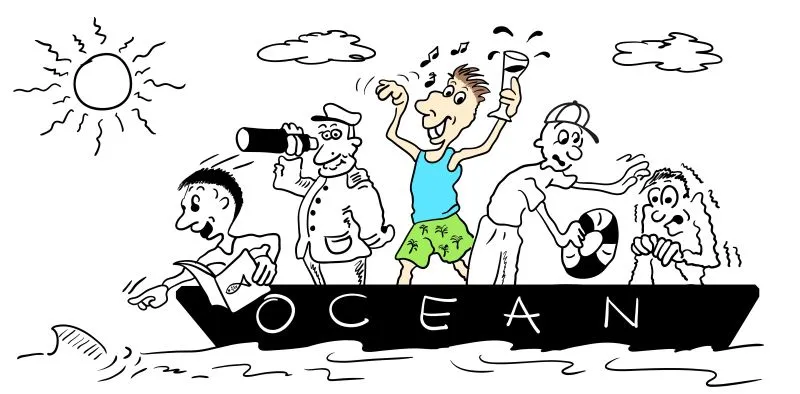
Extraversion is one of five dimensions of personality after Model of the Big Five (McCrae & Costa, 1987). It describes a person's tendency to prefer a diverse social environment rather than to feel comfortable in a quiet environment and with being alone. Extraversion consists of characteristics such as Sociability, activity, or inhibition together (Costa & McCrae, 1985).
Whereas it was previously assumed that the reserved versus energetic form of extraversion Create a pair of opposites and a person can be clearly assigned to one of the two categories, is what you can see today reticent and full of energy than two poles of a continuum the Extraversion dimension. The value of each person can therefore be located at one point on the following scale:
Reticent
For people who are safe rather reserved Behavior and not constantly seek the company of others, the following qualities, for example, are characteristic:
- reticent
- passively
- reserved
However, this should not be seen as a disadvantage in any case. Restrained people often prefer the Work alone in silence and usually feel more comfortable in such situations than their energetic counterpart. They are therefore particularly effective in occupations that require fewer social interactions, such as Engineer or scientist (Denissen et al., 2017).
Full of energy
People who rather energetic are and usually seek exchange and company with others, can be described with the following characteristics:
- actively
- vividly
- assertive
They flourish in social situations and actively seek contact with other people. This is also noticeable in a professional context, where energetic people, for example, in Marketing, Management, or Sales are particularly successful (Barrick & Mount, 1991) because they often act actively and assertively in such situations.
Benefits in a professional context
As you can see, it hangs best cast for a vacancy not only from the person's extraversion, but also from Characteristics of the vacancy. In classic test methods, however, applicants who are more energetic often have an advantage. Due to their open-minded, sociable nature, they score points in application processes (e.g. Spector et al., 2000). This often leads to incorrect adjustments in jobs for which a more reserved person would be much more suitable. With personality diagnostics, you can therefore Reduce the risk of misstaffing while ensuring greater diversity in the workplace!
How do you record extraversion?
Do you want to record the extraversion of your applicants? Aivy is happy to help you with this!
Our mini game “Self-knowledge” offers users the opportunity to brief self-assessment find out their individual value. This includes not only extraversion, but also the four other areas of the Big Five:
Sources
- Barrick, M.R., & Mount, M.K. (1991). The big five personality dimensions and job performance: a meta‐analysis. Personnel Psychology, 44 (1), 1-26.
- Costa, P.T., & McCrae, R.R. (1985). The NEO personality inventory. Odessa, FL: Psychological Assessment Resources.
- Denissen, J.J., Bleidorn, W., Hennecke, M., Luhmann, M., Orth, U., Specht, J., & Zimmermann, J. (2018). Uncovering the power of personality to shape income. Psychological Science, 29 (1), 3-13.
- McCrae, R.R., & Costa, P.T. (1987). Validation of the five-factor model of personality across instruments and observers. Journal of Personality and Social Psychology, 52 (1), 81.
- Spector, P.E., Schneider, J.R., Vance, C.A., & Hezlett, S.A. (2000). The relation of cognitive ability and personality traits to assessment center performance. Journal of Applied Social Psychology, 30 (7), 1474-1491.

Make a better pre-selection — even before the first interview
In just a few minutes, Aivy shows you which candidates really fit the role. Beyond resumes based on strengths.