
Online assessment: definition
An online assessment is an internet-based aptitude diagnostic procedure that measures job-relevant characteristics of applicants in order to predict their fit for a role (Konradt & Sarges, 2003). It does not replace a conversation – it provides the basis for one.
What separates it from an ordinary online test is construction. An online assessment is psychometrically developed and validated. It demonstrably measures what it claims to measure, and the link to later job performance is empirically established.
What an online assessment is made of
The composition follows from the requirement profile. What gets measured depends on what the role demands – not on what the tool happens to offer.
Four building blocks are common:
Cognitive ability tests capture processing speed, memory, logical reasoning and attention. In research they show the highest predictive power for job performance across occupational groups.
Personality measures assess job-related traits, usually along the five factors openness, conscientiousness, extraversion, agreeableness and emotional stability. Conscientiousness is the most stable predictor across nearly all types of work.
Interest measures map professional interests. They answer less the question „can this person do it?“ and more „will they still want to do it in three years?“
Values and fit measures capture the conditions under which someone works well – the basis for cultural fit.
Online assessments are used predominantly in pre-selection, where a large applicant pool needs to become a sensible shortlist (Ott, Ulfert & Kersting, 2017). Increasingly also in career orientation, as a self-assessment or potential analysis.
How an online assessment runs
Five steps in practice. The order matters – starting at step three means measuring the wrong things well.
1. Define the requirements. Before anything is measured, it has to be clear what the role actually demands. Six to eight observable characteristics are enough. Longer lists make decisions worse, because they dilute the weighting.
2. Assemble the procedure. The requirements determine which building blocks are needed. A customer service role calls for different measurements than software engineering.
3. Invitation and completion. Applicants usually receive access right after applying, often automated through the applicant tracking system. They complete it independently, without an appointment, on their own device.
4. Evaluation. Results are mirrored against the requirement profile. What comes out is not a ranking but a fit picture: where the strengths are, where the gaps are, what to probe in the interview.
5. Feedback. Applicants receive an evaluation of their strengths – including those who are rejected. That is not a nice extra, it is the return on the time they invested.
Almost all of the effort on the company side sits in steps one and two. Once the profile is defined, the rest runs without further input.
How it differs from related procedures
The terms get mixed up frequently. What separates them:
Online assessment and assessment center are not the same thing. An assessment center is a multi-hour in-person format with observers, group exercises and role plays. It is expensive and suited to the final stage with few candidates. An online assessment sits before that and works at scale.
Online assessment and aptitude test mean much the same thing. „Aptitude test“ emphasises the goal, „online assessment“ the delivery format.
Online assessment and self-assessment differ in purpose. A self-assessment is for the person taking it, for orientation, and the result stays with them. An online assessment in a hiring process collects data for a company decision.
What online assessments deliver
Objectivity and predictive power
Standardised delivery and computer-based scoring make the result independent of who evaluates it and how likeable someone seems. That is exactly where the usual judgement distortions operate during CV screening and interviews. An overview of the relevant patterns is in the entry on unconscious bias in recruiting.
This is not a side effect, it is the point: a procedure that produces two different results with two different evaluators is not measuring anything.
Efficiency
In-person selection days and assessment centers consume time, staff and travel budget. Putting an online assessment in front of them reduces how many people go through that effort at all.
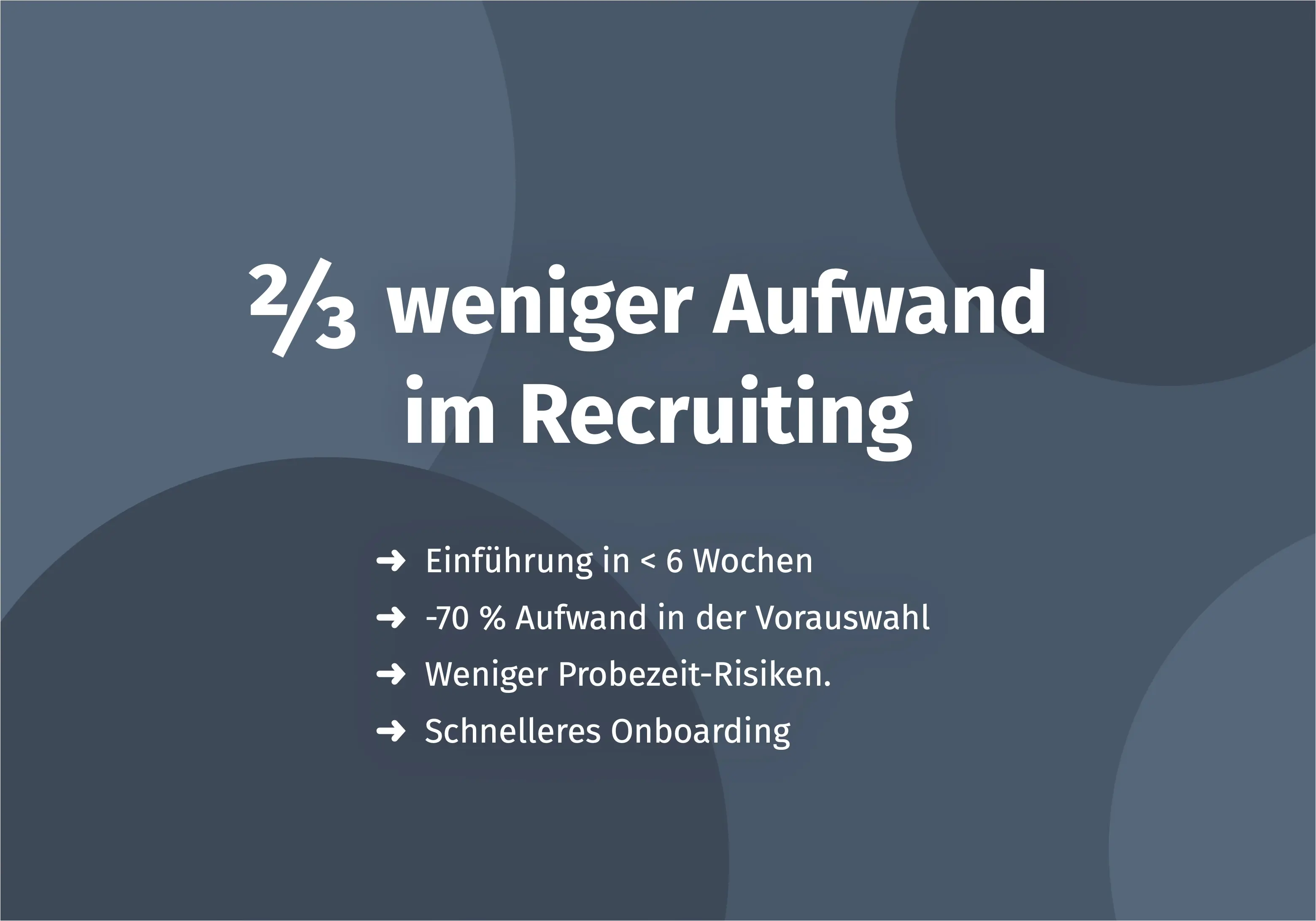
At Callways, screening effort dropped by 70 percent after the switch – with the same number of applications.
Applicant acceptance
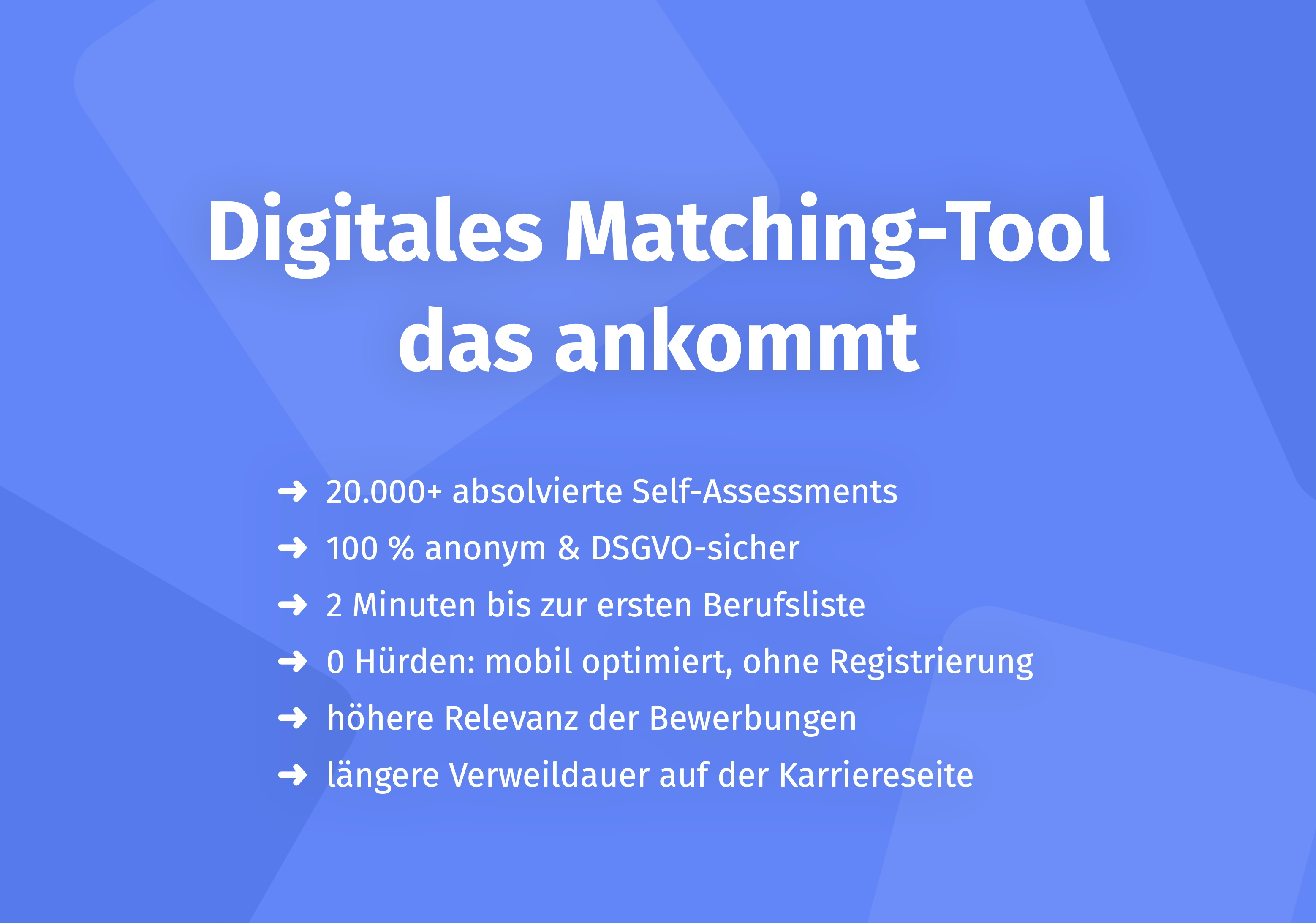
When and where to take the assessment is usually the applicant's choice. Most procedures run on a smartphone. That takes pressure out of the situation.
Acceptance is highest for game-based assessments – psychometrically developed mini-games that capture cognitive and personality-related characteristics through behaviour in play rather than through questionnaires. Frankfurt School measured a 30 percent better candidate experience compared to comparable procedures.
Effect on the employer brand
A selection procedure is a touchpoint like any other. Offering something applicants experience as fair and current says something about you – including to the people who get rejected (Kupka, Müller & Diercks, 2010).
Where the limits are
Risk of cheating
In an unsupervised procedure, help can be brought in – through aids or through other people. That is a real objection, not a theoretical one.
What matters when choosing a provider: does the procedure detect atypical response patterns? Are there formats that are hard to delegate? Is there re-testing when something looks off? A provider who waves the question away does not have an answer.
No substitute for the interview
Human fit is decided in conversation, not in a test. That is not a contradiction, it is division of labour.
Online assessments are rarely used for positive selection, meaning the final decision. Their job is negative selection: narrowing the field to those who bring what the requirement profile calls for. Humans still make the decision – on a better basis.
What a test cannot do
It measures characteristics, not people. It predicts probabilities, not certainties. And it is only as good as the requirement profile behind it: without knowing what the role demands, you measure precisely the wrong things – however good the instrument.
Quality criteria: how to recognise a sound procedure
Three questions every procedure must be able to answer:
Does it measure reliably? (Reliability) Does a repeat produce a comparable result?
Does it measure the right thing? (Validity) Is the link to job performance empirically established – not merely plausible?
Does it measure independently of the evaluator? (Objectivity) Do two evaluators reach the same result from the same responses?
DIN 33430 is the German standard that sets out these requirements for job-related aptitude assessment. It is not a certification but a norm for the process – from requirement analysis through to feedback.
Data protection sits alongside: where is the data processed, how long is it stored, who has access, and is collection pseudonymised?
Legal framework
Three layers matter, and none of them argues against using assessments – they define how they have to be built.
Job relevance. What may be measured are characteristics relevant to the work. A procedure that collects personal information unrelated to the role is exposed. Conversely, a documented, requirements-based procedure is a stronger legal position than a gut decision nobody can explain.
Data protection (GDPR). Assessment results are personal data. Purpose limitation, retention period, access rights and processing location all need answers. Pseudonymised collection reduces the risk considerably.
Co-determination. In companies with a works council, introducing a selection procedure requires their involvement. Bringing them in early avoids arguments later – and usually surfaces useful points about acceptance.
What matters when introducing one
From practice: these procedures rarely fail on technology. They fail on three other things.
The hiring team is not involved. When HR writes the requirement profile alone, it rarely fits. The people doing the work know which characteristics actually matter.
The result is read as a grade. A fit score is not a school mark and not a ranking. Using it that way replaces a subjective decision with a pseudo-objective one. The result belongs in the next stage as a basis for conversation, not as a cut-off without context.
Applicants get no feedback. Investing 15 minutes and receiving nothing back turns the procedure into an imposition. That is where it is decided whether an online assessment builds the employer brand or damages it.
At Callways, less than six weeks passed between the decision and full rollout. The effort was not in the implementation but in defining the target profiles.
From practice
Deutsche Lufthansa AG integrated Aivy into pre-selection for a trainee programme. After starting their application, candidates completed a 15-minute assessment made up of seven mini-games.
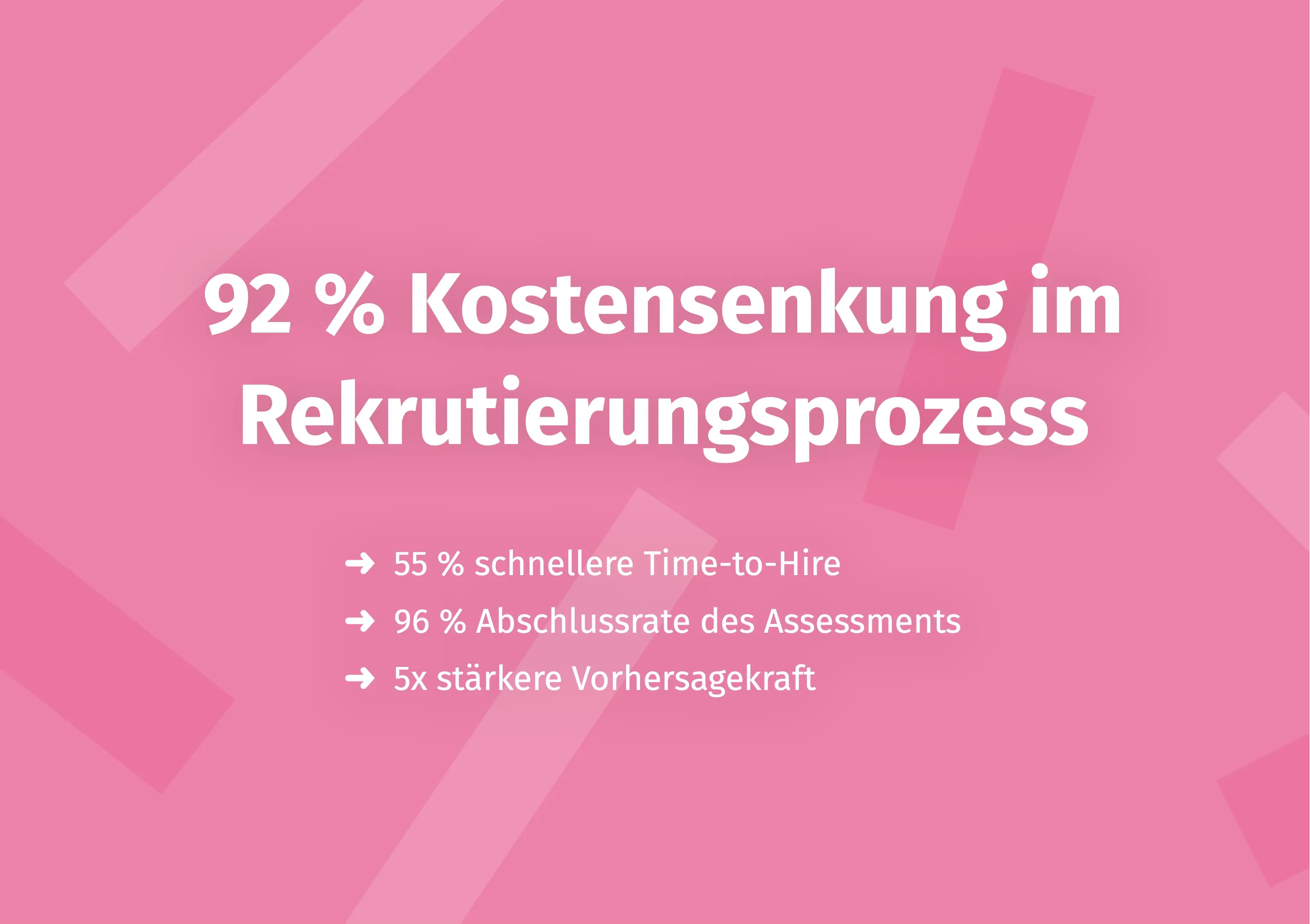
The assessment results were then compared with the ratings from the company's own assessment center. The procedure correctly predicted 96 percent of the suitability decisions – before the first personal conversation.
„We get a better view of the person and recognise their strengths. That lets us select for fit“, says Susanne Berthold Neumann, responsible for innovative young talent programmes at Deutsche Lufthansa AG.
How Aivy delivers online assessments
Aivy is a spin-off of Freie Universität Berlin. The procedures follow DIN 33430 and have been validated across more than one million completed assessments at over 200 companies. Development runs together with Harald Ackerschott, co-author of DIN 33430 and chair of the ISO working group on recruitment.
Data is processed on ISO 27001 certified servers in Frankfurt am Main, pseudonymised and audited regularly by independent parties.
Which procedures sit behind this and what each one measures is set out in the assessment overview.
Frequently asked questions
What is an online assessment?
An internet-based aptitude diagnostic procedure that measures job-relevant characteristics in order to predict fit for a role. It is used mostly in pre-selection.
How long does an online assessment take?
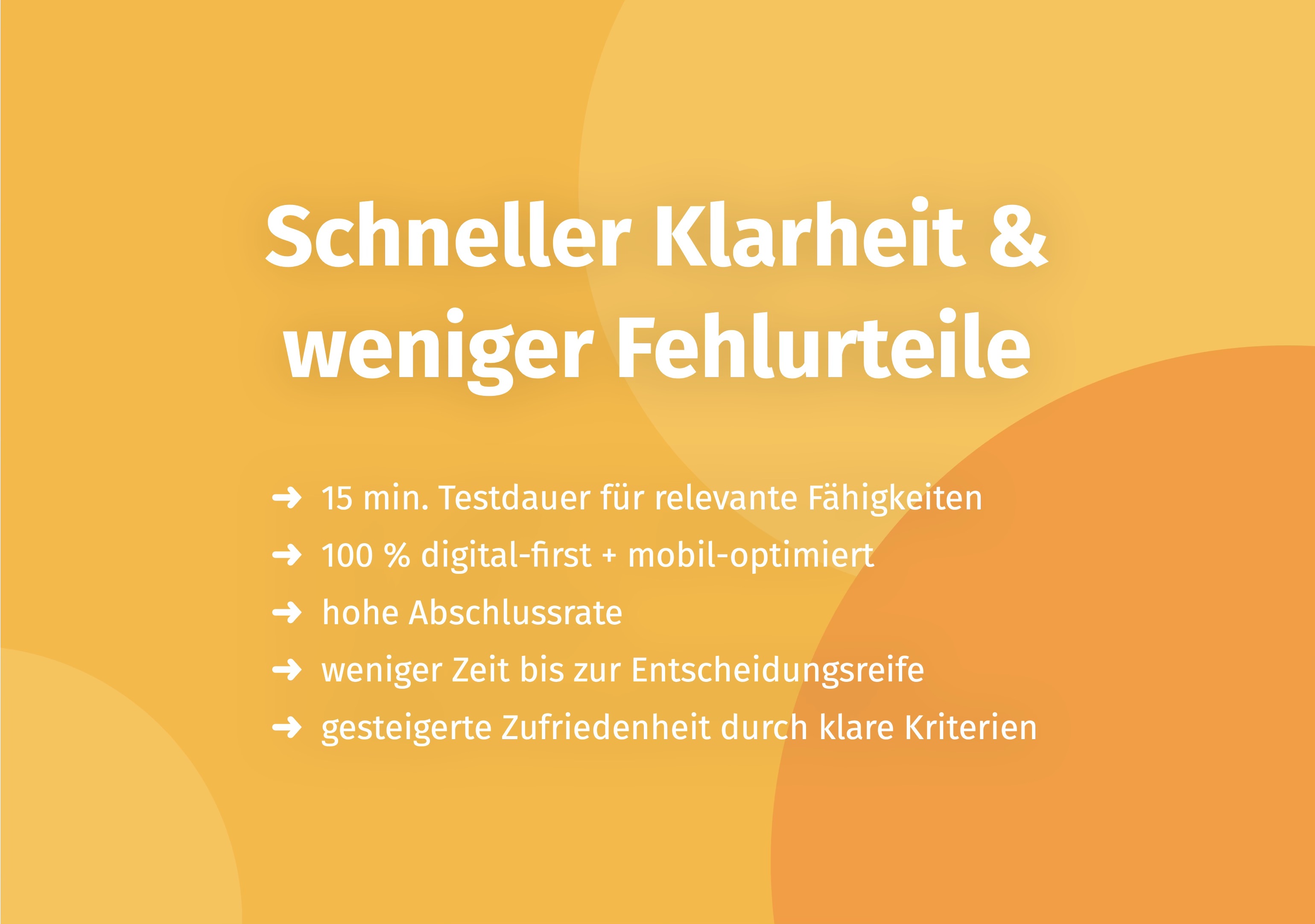
Between 10 and 60 minutes depending on scope. Procedures focused on the relevant characteristics manage in 15.
Does an online assessment replace the interview?
No. It narrows the field and gives the interview something to work with. The decision is made in conversation.
Are online assessments legally sound?
If they are job-related, based on a requirement profile and documented, yes. DIN 33430 describes the framework. It becomes critical with procedures that measure characteristics unrelated to the work.
How do I spot a poor procedure?
Missing figures on validity and reliability, results with no reference to a requirement profile, and providers who dodge the question about validation data.
Sources
- Diercks, J. (2020). Online-Assessment. In: Verhoeven, T. (ed.) Digitalisierung im Recruiting. Springer Gabler, Wiesbaden.
- Konradt, U., & Sarges, W. (2003). E-Recruitment und E-Assessment. Hogrefe, Göttingen.
- Kupka, K., Müller, V., & Diercks, J. (2010). Kombination von E-Assessment mit Web 2.0 Personalmarketing bei Media-Saturn. Zeitschrift für E-Learning, 2010(1).
- Ott, M., Ulfert, A.-S., & Kersting, M. (2017). Online-Assessments und Self-Assessments in der Eignungsdiagnostik. In: Krause, D. (ed.) Personalauswahl. Springer Gabler, Wiesbaden.
- DIN 33430: Requirements for job-related aptitude assessment.

Make a better pre-selection — even before the first interview
In just a few minutes, Aivy shows you which candidates really fit the role. Beyond resumes based on strengths.