You want to explore your strengths as a talent?

This way

Login

Scientific aptitude diagnostics in personnel selection

Home
-
Lexicon
-
Scientific aptitude diagnostics in personnel selection

This is how you make the best personnel decisions!

Aptitude diagnostics, also personnel diagnostics, is a collective term for psychological selection processes that are used to check a fit between applicants and workplace requirements (Schuler & Hoff 2007).

The term aptitude diagnosis does not refer to a single test, but to various psychological selection process and approaches to measure workplace-related competencies, characteristics and behavioural tendencies.

The procedures are united by a common goal: The prediction of whether an applicant will be successful in a specific position. As a result, aptitude diagnosis is closely related to the concept of Potential analysis, whose aim is to make statements about individuals' development opportunities.

Definition: aptitude diagnosis

Aptitude diagnostics is the use of psychological selection processes to record a person's competencies, abilities, behavior and values in a professional context.

Where, when and why are aptitude diagnostic methods used?

Possible fields of application for aptitude diagnostic methods, including psychometric methods, include career guidance, the Staff selection And the personnel development. While it is the case with career guidance and the Staff selection In particular, it is about determining the fit between the competencies of applicants and the requirements of a job, personnel development is primarily about identifying possible discrepancies between the current competencies of employees and the existing or future requirements in a job and thus identifying training and development needs. Similar to how a medical diagnosis forms the basis for subsequent therapy, psychological aptitude diagnostics thus provides the basis for career decisions, personnel decisions and personnel development measures.

Advantage of aptitude diagnostics

Used correctly, aptitude diagnostics is an important tool for personnel selection in order to make successful personnel decisions, define employee development potential and avoid incorrect appointments.

What aptitude diagnostic procedures are there?

Without explicitly referring to it as aptitude diagnosis, you are probably already using appropriate procedures today. This is because the review of application documents can also represent an aptitude diagnostic procedure provided that it follows certain pre-defined rules. This is how she distinguishes DIN 33430, which determines the requirements for scientifically based aptitude diagnosis, a total of five aptitude diagnosis methods:

  1. Document analysis (e.g. review of CVs, certificates and references)
  2. Direct oral surveys (e.g. telephone and personal interviews)
  3. Behavioral monitoring and assessment (e.g. role-playing games, work samples)
  4. Questionnaires based on measurement theory: (e.g. personality tests, integrity tests)
  5. Performance tests based on measurement theory: (e.g. intelligence tests, concentration tests)

Based on measurement theory means that the tests and questionnaires are based on a scientifically based theory were constructed, which mostly comes from the field of academic psychology. In addition to scientific-theoretical foundations, the metrological basis of tests and questionnaires also includes the professional use of mathematical and statistical models and evaluation methods.

How does vocational aptitude diagnostics work?

Every scientifically based aptitude diagnosis always starts with the definition of the term “suitability.” The central central question is: Suitable for what? This is because there is no higher-level test to determine general suitability for a wide range of activities. Rather, as part of a Requirements analysis The competencies and characteristics applicants must have in order to be successful in a specific position are defined in a specific manner and as specifically as possible. Such competencies that are decisive for professional success, such as the ability to solve complex problems, empathy or adaptability, are developed in a requirement profile defined. The requirement profile thus forms the basis for scientifically based and successful aptitude diagnostics

What should aptitude diagnostic methods measure? And what's not?

Good aptitude diagnostics are characterized by the fact that all requirements specified in the requirement profile are objective, reliable and free of measurement errors (i.e. reliable) measures where the cognitive, personality-based and behavior-based characteristics defined in the requirement profile are directly related to professional success (i.e. valid are). From this definition, it is also possible to deduce what aptitude diagnostics should not or should not measure: namely all those criteria that are not directly related to professional success at work. Examples include the political or sexual orientation of applicants. In addition, the procedures used should fairly be, i.e. do not systematically discriminate against groups (e.g. on the basis of gender or nationality), and are characterized by a high level of transparency. In this context, high transparency means that applicants always know exactly why which information is being collected about them, for what purpose and for how long it is stored, and what feedback they can expect themselves based on the test results. This is also known as social validity referred to.

How can you recognize good aptitude diagnostics?

Qualitatively and scientifically based aptitude diagnostics are characterized by the fact that it uses psychometric methods that meet the previously defined requirements, i.e. measure job-related competencies objectively, reliably, validly and fairly. If this is the case, no other personnel selection criterion (e.g. testimonies, Assessment Center) is an equally reliable prediction of applicants' professional suitability. But care must be taken. Because only scientifically based aptitude diagnostic tests lead to meaningful and reliable results and Not all processes available on the market meet this requirement. Therefore, procedures should always be checked for objectivity, reliability, validity and fairness before they are incorporated into your personnel selection. While objectivity, reliability, validity and fairness are among the central quality criteria of classical test theory, ancillary quality criteria also win Economy and acceptance increasingly important and should not be neglected when selecting suitable processes and providers. Ideally, the psychometric methods used are not only scientifically based and reliably predict the professional success of applicants, but are also cost-effective, can be used with little effort for applicants and companies and are accepted and popular with applicants.

To make it easier for you to find your way around the market, we have prepared a checklist summarizes how you can recognize good aptitude diagnostics and what you should pay attention to when choosing a provider.

Case studies from practice

Deutsche Lufthansa AG provides a current practical example of the effectiveness of scientifically based aptitude diagnostics. Through the use of scientifically validated psychometric testing methods from Aivy Could a A remarkable hit rate of 96% is achieved when pre-selecting trainees — and that even before the first personal interview.

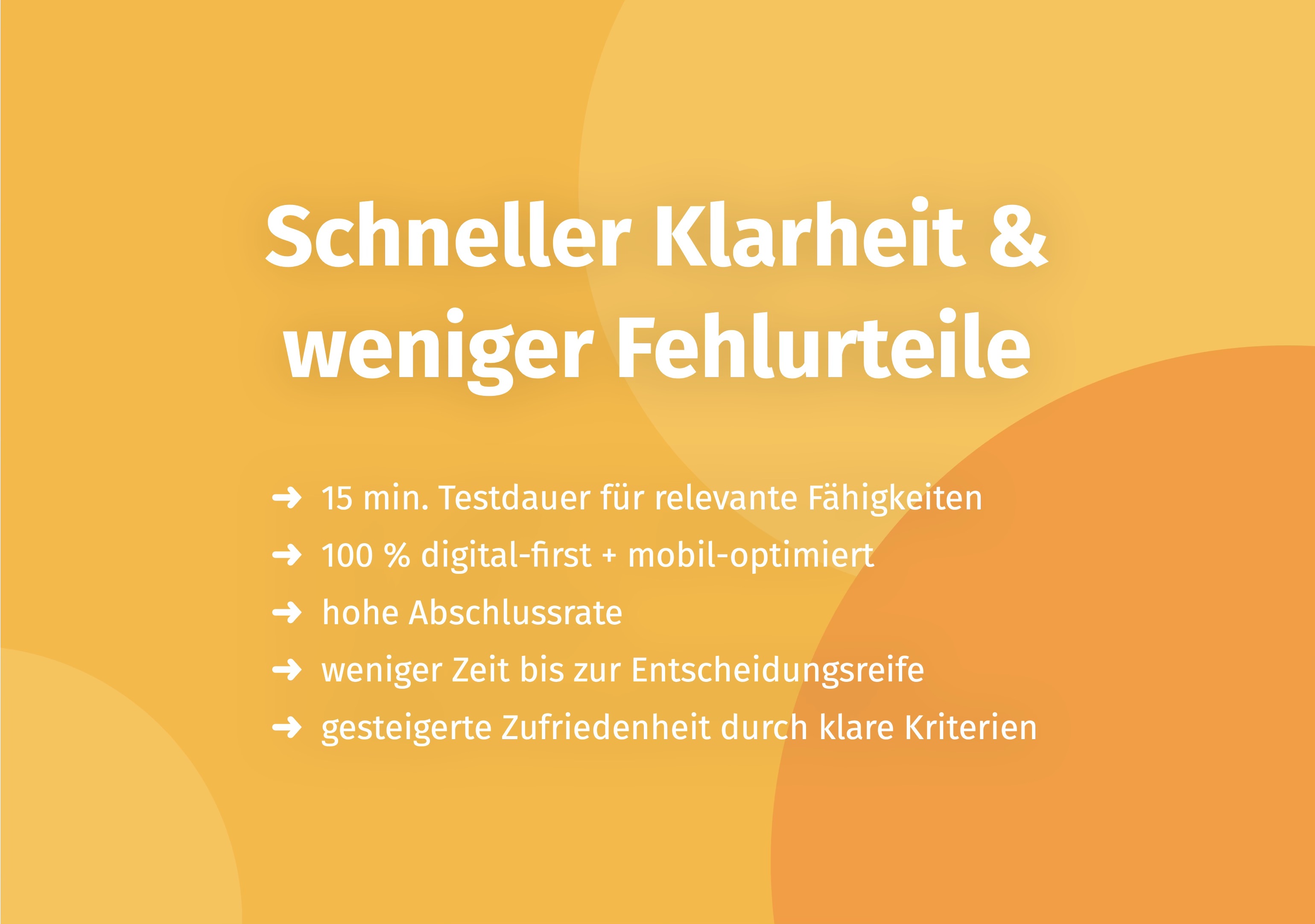
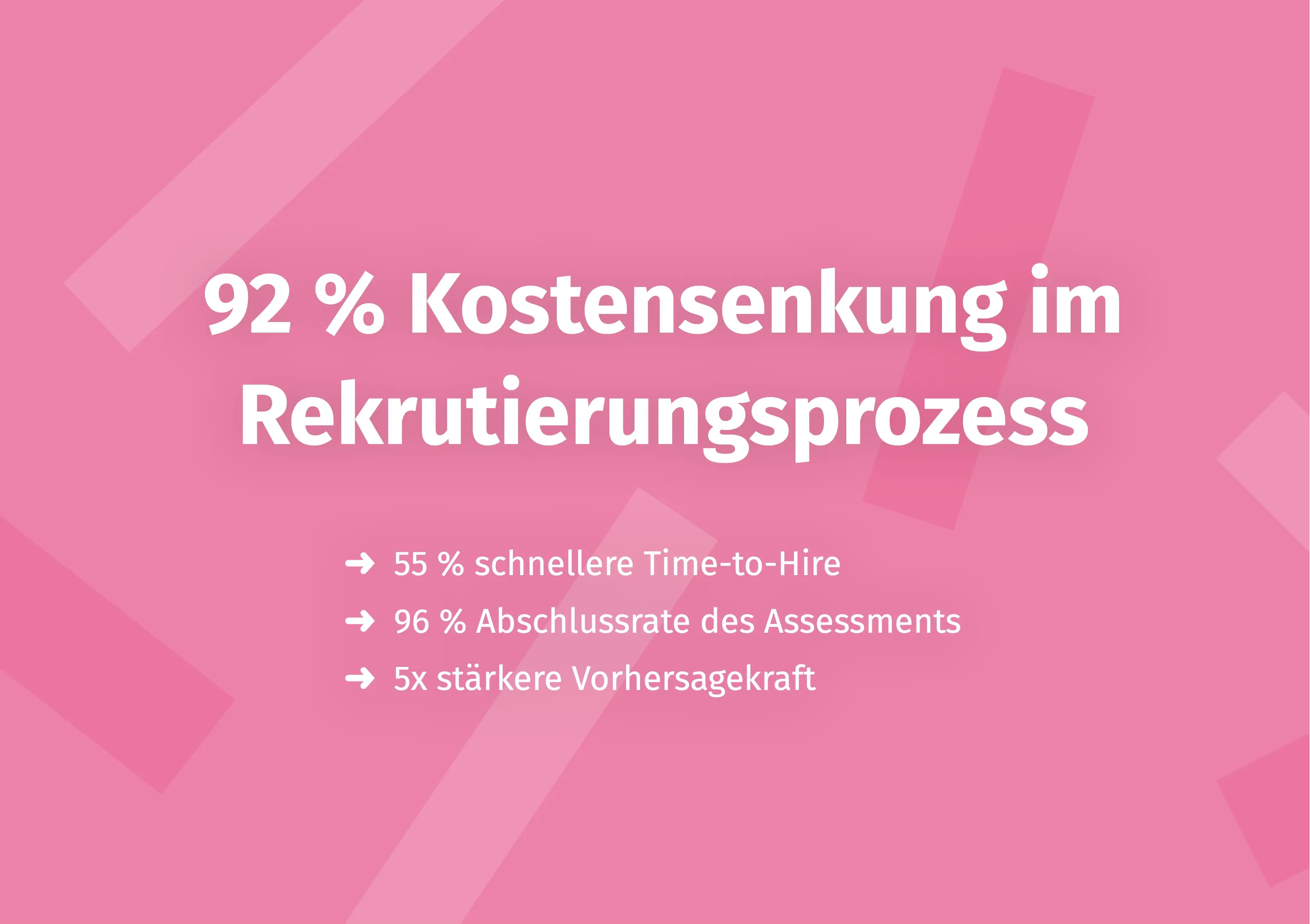
Implementing a 15-minute Online assessments The existing application process led to:

  • An overall success rate of 96% for candidate suitability
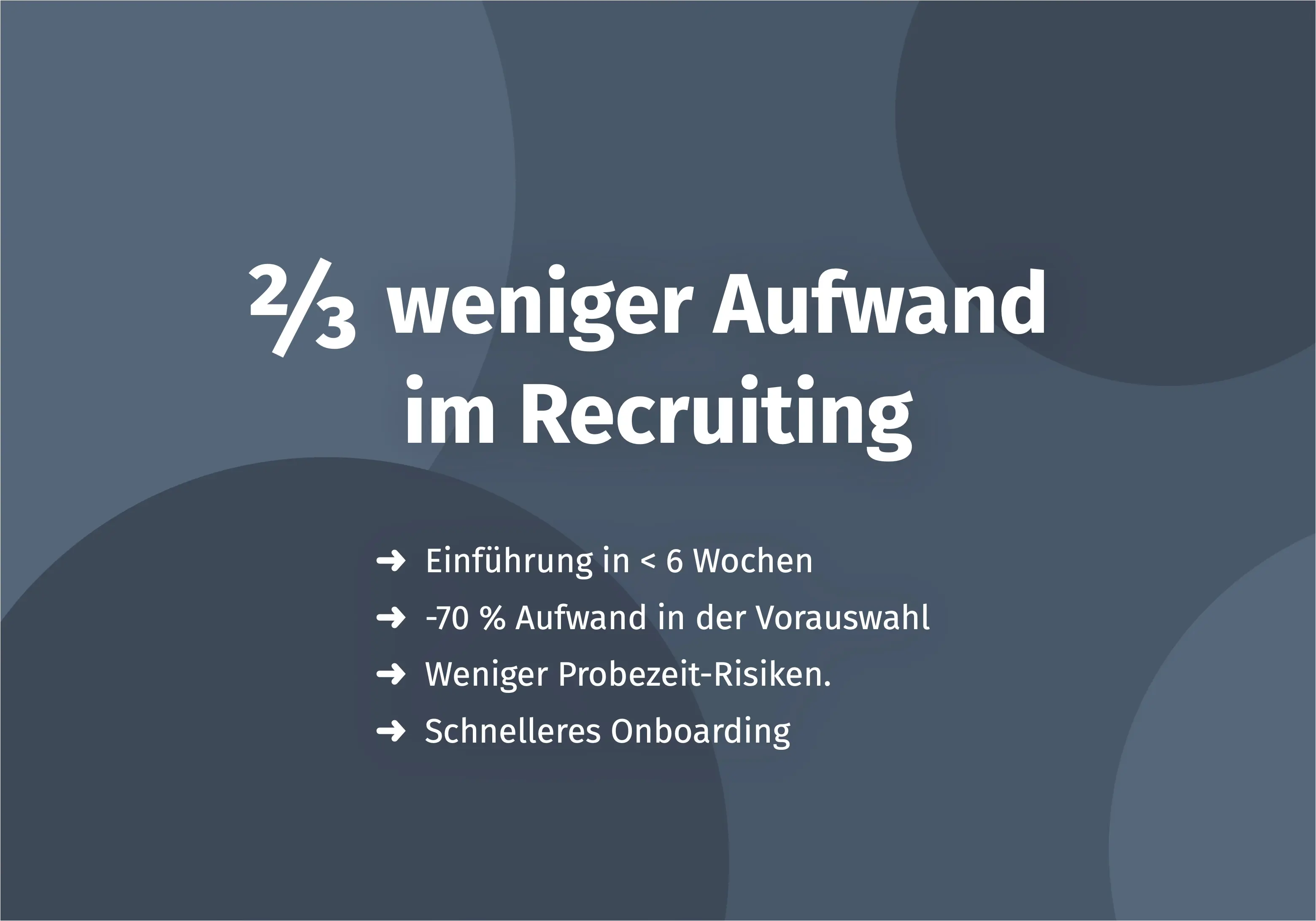
  • A time saving of over 100 minutes per application
  • A high level of acceptance among applicants with 86% completion rate

The high predictive accuracy of the process was demonstrated by a sample of over 1,200 applicants.

Testimonials from HR managers

“We get a better look at the person and recognize their strengths. This allows us to select according to fit,” confirms Susanne Berthold Neumann, responsible for innovative young talent programs at Deutsche Lufthansa AG.

The combination of scientific background and positive candidate experience makes modern aptitude diagnostics particularly valuable for companies. More about this here...

Quality standards

When carrying out aptitude diagnostic procedures, the Scientificity of the methods used as well as the Protection of personal data in focus:

  • Processing on ISO 27001-certified servers in Germany (Frankfurt am Main)
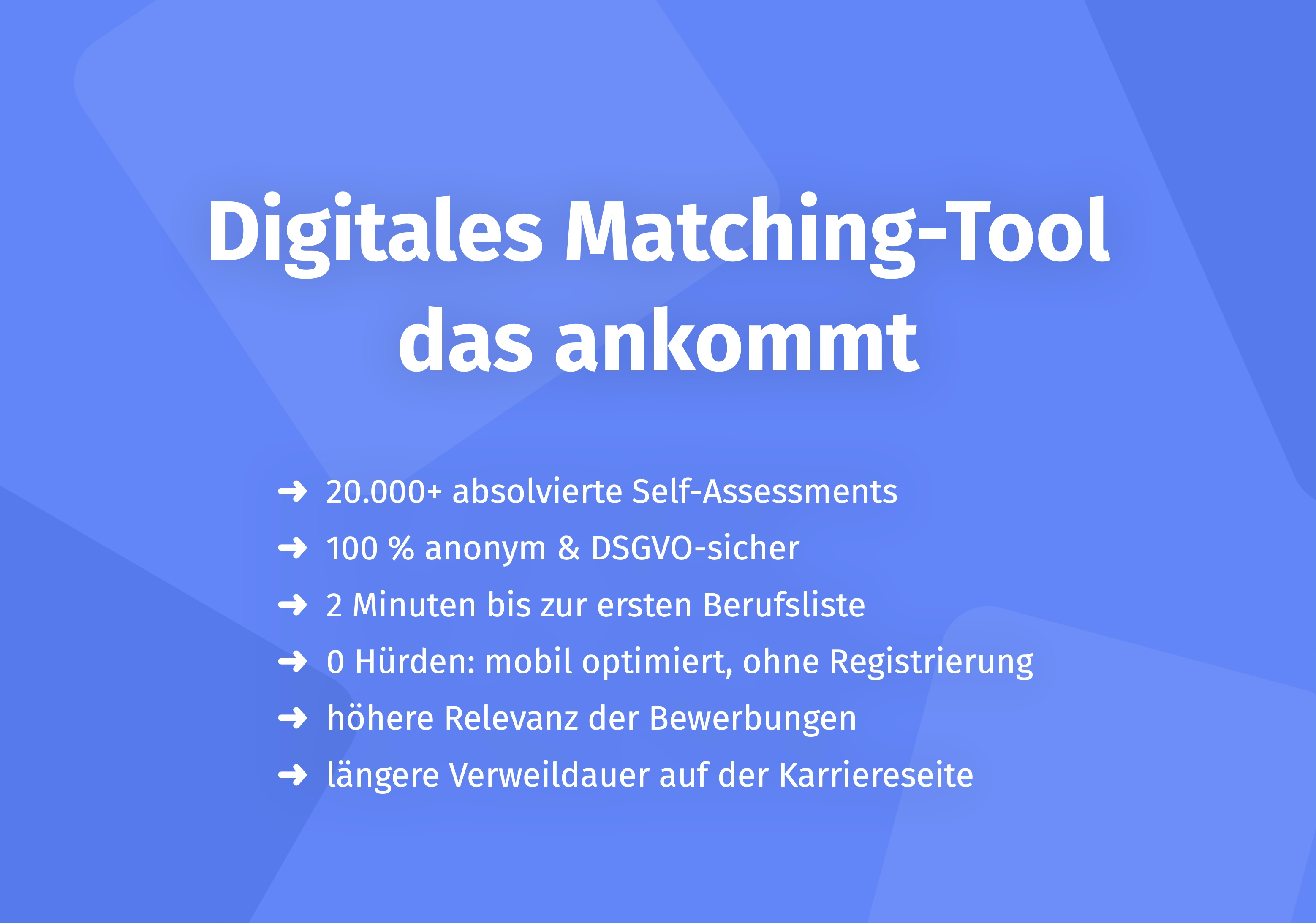
  • Pseudonymized data collection to ensure anonymity
  • Regular review by independent auditors (GDPR and BDSG)

As scientific spin-off of Freie Universität Berlin Aivy developed aptitude diagnostic methods that are based on DIN 33430 and have been validated in over 500,000 tests at more than 100 companies of various sizes and industries. The development is carried out in close cooperation with leading experts, including Harald Ackerschott, co-author of DIN 33430 and head of the ISO Recruitment Working Group.

Sources

  • DIN German Institute for Standardization e.V. (2016). Requirements for procedures and their
  • Use in job-related aptitude assessments — DIN 33430. Berlin: Beuth.
  • Diagnostic and Test Board (ed.). (2018c). Competently design personnel selection. Basics and practice of aptitude diagnostics in accordance with DIN 33430. Berlin: Springer.
  • Kanning, U.P. (2019). Personnel diagnostics standards. Design personnel selection professionally (2nd, revised and expanded edition). Göttingen: Hogrefe.
  • Schuler, H. & Hoft, S. (2007). Diagnosis of professional aptitude and performance. In H. Schuler (ed.), textbook Organizational Psychology (pp. 289—343). Bern: Huber.
  • Schuler, H. & Kanning, U.P. (2014). Textbook of personnel psychology (3rd edition). Göttingen: Hogrefe.

Home
-
lexicon
-
Scientific aptitude diagnostics in personnel selection

This is how you make the best personnel decisions!

Aptitude diagnostics, also personnel diagnostics, is a collective term for psychological selection processes that are used to check a fit between applicants and workplace requirements (Schuler & Hoff 2007).

The term aptitude diagnosis does not refer to a single test, but to various psychological selection process and approaches to measure workplace-related competencies, characteristics and behavioural tendencies.

The procedures are united by a common goal: The prediction of whether an applicant will be successful in a specific position. As a result, aptitude diagnosis is closely related to the concept of Potential analysis, whose aim is to make statements about individuals' development opportunities.

Definition: aptitude diagnosis

Aptitude diagnostics is the use of psychological selection processes to record a person's competencies, abilities, behavior and values in a professional context.

Where, when and why are aptitude diagnostic methods used?

Possible fields of application for aptitude diagnostic methods, including psychometric methods, include career guidance, the Staff selection And the personnel development. While it is the case with career guidance and the Staff selection In particular, it is about determining the fit between the competencies of applicants and the requirements of a job, personnel development is primarily about identifying possible discrepancies between the current competencies of employees and the existing or future requirements in a job and thus identifying training and development needs. Similar to how a medical diagnosis forms the basis for subsequent therapy, psychological aptitude diagnostics thus provides the basis for career decisions, personnel decisions and personnel development measures.

Advantage of aptitude diagnostics

Used correctly, aptitude diagnostics is an important tool for personnel selection in order to make successful personnel decisions, define employee development potential and avoid incorrect appointments.

What aptitude diagnostic procedures are there?

Without explicitly referring to it as aptitude diagnosis, you are probably already using appropriate procedures today. This is because the review of application documents can also represent an aptitude diagnostic procedure provided that it follows certain pre-defined rules. This is how she distinguishes DIN 33430, which determines the requirements for scientifically based aptitude diagnosis, a total of five aptitude diagnosis methods:

  1. Document analysis (e.g. review of CVs, certificates and references)
  2. Direct oral surveys (e.g. telephone and personal interviews)
  3. Behavioral monitoring and assessment (e.g. role-playing games, work samples)
  4. Questionnaires based on measurement theory: (e.g. personality tests, integrity tests)
  5. Performance tests based on measurement theory: (e.g. intelligence tests, concentration tests)

Based on measurement theory means that the tests and questionnaires are based on a scientifically based theory were constructed, which mostly comes from the field of academic psychology. In addition to scientific-theoretical foundations, the metrological basis of tests and questionnaires also includes the professional use of mathematical and statistical models and evaluation methods.

How does vocational aptitude diagnostics work?

Every scientifically based aptitude diagnosis always starts with the definition of the term “suitability.” The central central question is: Suitable for what? This is because there is no higher-level test to determine general suitability for a wide range of activities. Rather, as part of a Requirements analysis The competencies and characteristics applicants must have in order to be successful in a specific position are defined in a specific manner and as specifically as possible. Such competencies that are decisive for professional success, such as the ability to solve complex problems, empathy or adaptability, are developed in a requirement profile defined. The requirement profile thus forms the basis for scientifically based and successful aptitude diagnostics

What should aptitude diagnostic methods measure? And what's not?

Good aptitude diagnostics are characterized by the fact that all requirements specified in the requirement profile are objective, reliable and free of measurement errors (i.e. reliable) measures where the cognitive, personality-based and behavior-based characteristics defined in the requirement profile are directly related to professional success (i.e. valid are). From this definition, it is also possible to deduce what aptitude diagnostics should not or should not measure: namely all those criteria that are not directly related to professional success at work. Examples include the political or sexual orientation of applicants. In addition, the procedures used should fairly be, i.e. do not systematically discriminate against groups (e.g. on the basis of gender or nationality), and are characterized by a high level of transparency. In this context, high transparency means that applicants always know exactly why which information is being collected about them, for what purpose and for how long it is stored, and what feedback they can expect themselves based on the test results. This is also known as social validity referred to.

How can you recognize good aptitude diagnostics?

Qualitatively and scientifically based aptitude diagnostics are characterized by the fact that it uses psychometric methods that meet the previously defined requirements, i.e. measure job-related competencies objectively, reliably, validly and fairly. If this is the case, no other personnel selection criterion (e.g. testimonies, Assessment Center) is an equally reliable prediction of applicants' professional suitability. But care must be taken. Because only scientifically based aptitude diagnostic tests lead to meaningful and reliable results and Not all processes available on the market meet this requirement. Therefore, procedures should always be checked for objectivity, reliability, validity and fairness before they are incorporated into your personnel selection. While objectivity, reliability, validity and fairness are among the central quality criteria of classical test theory, ancillary quality criteria also win Economy and acceptance increasingly important and should not be neglected when selecting suitable processes and providers. Ideally, the psychometric methods used are not only scientifically based and reliably predict the professional success of applicants, but are also cost-effective, can be used with little effort for applicants and companies and are accepted and popular with applicants.

To make it easier for you to find your way around the market, we have prepared a checklist summarizes how you can recognize good aptitude diagnostics and what you should pay attention to when choosing a provider.

Case studies from practice

Deutsche Lufthansa AG provides a current practical example of the effectiveness of scientifically based aptitude diagnostics. Through the use of scientifically validated psychometric testing methods from Aivy Could a A remarkable hit rate of 96% is achieved when pre-selecting trainees — and that even before the first personal interview.

Implementing a 15-minute Online assessments The existing application process led to:

  • An overall success rate of 96% for candidate suitability
  • A time saving of over 100 minutes per application
  • A high level of acceptance among applicants with 86% completion rate

The high predictive accuracy of the process was demonstrated by a sample of over 1,200 applicants.

Testimonials from HR managers

“We get a better look at the person and recognize their strengths. This allows us to select according to fit,” confirms Susanne Berthold Neumann, responsible for innovative young talent programs at Deutsche Lufthansa AG.

The combination of scientific background and positive candidate experience makes modern aptitude diagnostics particularly valuable for companies. More about this here...

Quality standards

When carrying out aptitude diagnostic procedures, the Scientificity of the methods used as well as the Protection of personal data in focus:

  • Processing on ISO 27001-certified servers in Germany (Frankfurt am Main)
  • Pseudonymized data collection to ensure anonymity
  • Regular review by independent auditors (GDPR and BDSG)

As scientific spin-off of Freie Universität Berlin Aivy developed aptitude diagnostic methods that are based on DIN 33430 and have been validated in over 500,000 tests at more than 100 companies of various sizes and industries. The development is carried out in close cooperation with leading experts, including Harald Ackerschott, co-author of DIN 33430 and head of the ISO Recruitment Working Group.

Sources

  • DIN German Institute for Standardization e.V. (2016). Requirements for procedures and their
  • Use in job-related aptitude assessments — DIN 33430. Berlin: Beuth.
  • Diagnostic and Test Board (ed.). (2018c). Competently design personnel selection. Basics and practice of aptitude diagnostics in accordance with DIN 33430. Berlin: Springer.
  • Kanning, U.P. (2019). Personnel diagnostics standards. Design personnel selection professionally (2nd, revised and expanded edition). Göttingen: Hogrefe.
  • Schuler, H. & Hoft, S. (2007). Diagnosis of professional aptitude and performance. In H. Schuler (ed.), textbook Organizational Psychology (pp. 289—343). Bern: Huber.
  • Schuler, H. & Kanning, U.P. (2014). Textbook of personnel psychology (3rd edition). Göttingen: Hogrefe.

Heading 1

Heading 2

Heading 3

Heading 4

Heading 5
Heading 6

Lorem ipsum dolor sit amet, consectetur adipiscing elit, sed do eiusmod tempor incididunt ut laboratories et dolore magna aliqua. Ut Enim ad Minim Veniam, Quis Nostrud Exercitation Ullamco Laboris Nisi ut Aliquip ex ea Commodo Consequat. Duis aute irure dolor in reprehenderite in voluptate velit eat cillum dolore eu fugiate nulla pariature.

Block quote

Ordered list

  1. Item 1
  2. Item 2
  3. Item 3

Unordered list

  • Item A
  • Item B
  • Item C

Text link

Bold text

Emphasis

Superscript

Subscript

Heading 1

Heading 2

Heading 3

Heading 4

Heading 5
Heading 6

Lorem ipsum dolor sit amet, consectetur adipiscing elit, sed do eiusmod tempor incididunt ut laboratories et dolore magna aliqua. Ut Enim ad Minim Veniam, Quis Nostrud Exercitation Ullamco Laboris Nisi ut Aliquip ex ea Commodo Consequat. Duis aute irure dolor in reprehenderite in voluptate velit eat cillum dolore eu fugiate nulla pariature.

Block quote

Ordered list

  1. Item 1
  2. Item 2
  3. Item 3

Unordered list

  • Item A
  • Item B
  • Item C

Text link

Bold text

Emphasis

Superscript

Subscript

Use aptitude diagnostics effectively in your own recruiting!

Receive further information by e-mail without obligation...

Dr. Aline Lanzrath

Content specialist

About Aline

Completed her doctorate in business administration at the University of Mannheim and researches current issues in the areas of talent management, organizational culture and employer branding. She previously studied psychology there with a focus on work and organizational psychology as well as market and advertising psychology. She also has practical experience in personnel development, strategy consulting and market research.

success stories

You can expect these results

Discover what successes other companies are achieving by using Aivy. Be inspired and do the same as they do.

Many innovative employers already rely on Aivy

Say that #HeRoes

“Through the very high response rate Persuade and retain We our trainees early in the application process. ”

Tamara Molitor
Training manager at Würth
Tamara Molitor

“That Strengths profile reflects 1:1 our experience in a personal conversation. ”

Wolfgang Böhm
Training manager at DIEHL
Wolfgang Böhm Portrait

“Through objective criteria, we promote equal opportunities and Diversity in recruiting. ”

Marie-Jo Goldmann
Head of HR at Nucao
Marie Jo Goldmann Portrait

Aivy is the bestWhat I've come across so far in the German diagnostics start-up sector. ”

Carl-Christoph Fellinger
Strategic Talent Acquisition at Beiersdorf
Christoph Feillinger Portrait

“Selection process which Make fun. ”

Anna Miels
Learning & Development Manager at apoproject
Anna Miels Portrait

“Applicants find out for which position they have the suitable competencies bring along. ”

Jürgen Muthig
Head of Vocational Training at Fresenius
Jürgen Muthig Fresenius Portrait

“Get to know hidden potential and Develop applicants in a targeted manner. ”

Christian Schütz
HR manager at KU64
Christian Schuetz

Saves time and is a lot of fun doing daily work. ”

Matthias Kühne
Director People & Culture at MCI Germany
Matthias Kühne

Engaging candidate experience through communication on equal terms. ”

Theresa Schröder
Head of HR at Horn & Bauer
Theresa Schröder

“Very solid, scientifically based, innovative even from a candidate's point of view and All in all, simply well thought-out. ”

Dr. Kevin-Lim Jungbauer
Recruiting and HR Diagnostics Expert at Beiersdorf
Kevin Jungbauer
YOUR assistant FOR TALENT ASSESSMENT

Try it for free

Become a HeRo 🦸 and understand candidate fit - even before the first job interview...